
Overlaps: UV light source in the cap, rechargeable battery. Differs: activated by a button, not by closing the cap.
I have an invention and no map
I have an idea.Now what?
I've made notes, run a few searches, even asked ChatGPT. What I need now is a clear next step: find out what already exists, understand it, and turn my idea into a patent application.
- Notes in three different apps. One of them is a napkin.
- Googled “how to patent an idea.” Opened eleven tabs.
- Opened Google Patents. Didn't understand what I was looking at. Closed it.
- Asked ChatGPT. Still not sure.
- Can I actually patent this?
I think this is new. I searched Google and didn't find the same thing.
But does that mean I can patent it?
Maybe not. Patents describe inventions in technical and legal language I'd never type into Google. Before anything else, I want to search where patents actually live and see what's closest to my idea.
How prior art search works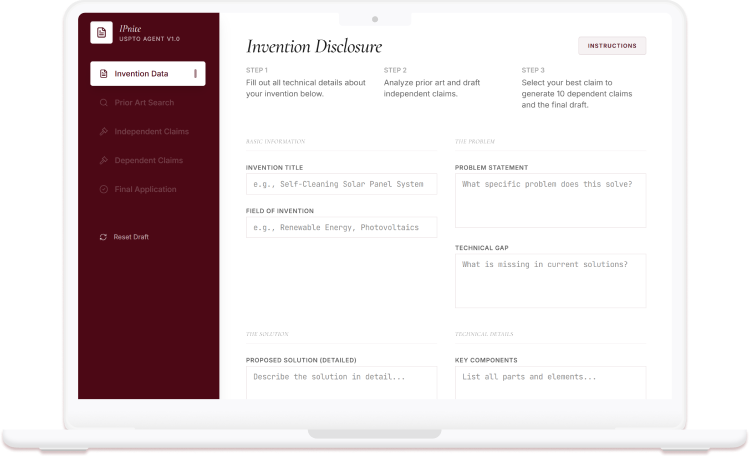
I found hundreds of patents. Which ones actually matter?
I don't need hundreds of results. I need the closest ones, and to understand what makes my idea different from each of them.
Example
What my search gave me
- US 2019/0xxxxxx — Bottle closure with integrated…
- EP 3 xxx xxx — Apparatus and method for the sterilization of…
- WO 2020/xxxxxx — Portable fluid treatment device comprising…
- US 10,xxx,xxx — System for irradiating a liquid in a vessel…
- CN 11xxxxxxx — Bottle cap assembly having a light-emitting…
…and hundreds more, in dense legal language.
Example Closest match · High overlap Related · Partial overlap
What I actually need to see
A closure sensor that triggers an action when a vessel is sealed. Different purpose, similar mechanism.
That difference might be where my invention lives.
How I can find what makes my idea differentI can explain my invention. I have no idea how to turn it into a patent.
Can I write a patent myself?
I can prepare it step by step: describe the problem my invention solves and how it solves it, define what I want to protect, and end up with a structured application ready for professional review.
My words
“It's a cap that cleans the water with UV light every time I close it, so I don't have to remember to press anything.”
Structured claim
“A closure for a liquid vessel, comprising: a housing; an ultraviolet light source disposed within the housing; and a sensor configured to detect engagement of the closure with the vessel and, in response, to activate the light source.”
- DescribeThe technical problem, the solution and the alternatives
- ClaimsThe features I want to protect
- SpecificationThe technical description and abstract
- DrawingsReference figures that support the text
- QAA consistency and formatting review
- ExportA document ready for review and filing
I'm about to put an unpublished invention into AI. Where does it actually go?
Before I type my idea anywhere, I want to know exactly where it goes and who can use it.
| General-purpose AI chat | IPnite™ | |
|---|---|---|
| What is it built for? | Open-ended conversation on any topic | One job: a structured patent workflow |
| Is my invention used to train AI models? | Depends on the product and its settings. I'd have to check its policy. | My inventions, prompts, documents and drafts aren't used to train AI models. |
| Who owns my idea? | Governed by that product's terms | Everything generated from my information belongs to me. |
| What do I get? | Answers in a chat window | Claims, specification and abstract, reference drawings, a quality review and a DOCX export |
If I disclose my invention myself, the United States still gives me one year to file; many other countries are stricter, so filing first keeps my options open.Source: 35 U.S.C. 102(b)(1) · MPEP Appendix L (USPTO)
How IPnite™ handles my dataThe attorney quote is more than I expected. Do I need that before I even know if this is worth pursuing?
Do I need an attorney already?
Maybe, eventually. But I can arrive prepared, so I'm paying for their judgment, not for the basics.
- Me
The idea
Notes, sketches, what makes it work
- With IPnite™
Search, structure, draft
Prior art understood, application drafted
- Professional review
Judgment and filing
Strategy, scope and where to file


IPnite™ doesn't replace legal advice. It helps me prepare.
I just need to get this one idea moving.
How much is all of this going to cost?
I see three paths. The middle one lets me start without betting everything.
On my own
Free tools. Plus a lot of my time, and it's hard to know what I'm missing.
The Drafter
$99per draft
One-time payment. No subscription.
- Independent and dependent claims
- Technical specification and abstract
- Reference drawings
- Quality review (QA)
- DOCX export
Professional drafting
Depends on the professional and on my invention. I'd ask for a quote. Full legal judgment, worth it once I know my idea is worth pursuing.
Official patent office fees are separate and paid to the office where I file. USPTO fee schedule →
Later, maybe:
What if I keep having ideas?
Then I'll want everything in one place: search, drafting and my portfolio. I can try the platform free for 7 days, with no credit card and no automatic charges.
Inventor
$50/mo
For independent inventors protecting and managing their ideas.
Startup
$199/mo
For startups building and managing an IP portfolio.
Institutional
$499/mo
For law firms, universities, TTOs and IP teams. Includes 3 users.
Where would I file?
If I file in the United States, my application goes to the USPTO.
That's not my only option. If I want protection in other countries too, the PCT is one way to do it.
How the PCT route worksLast reviewed: September 28, 2026. General information, not legal advice. Deadlines and rules depend on the office; I confirm them with the official source or a patent professional.