
IPnite™ PATENT GUIDE
How Do I Write a Patent Application?
Start with the invention, not the form. Describe the problem and how your solution works, define what you want to protect in the claims, and support both with drawings. This guide covers the order that works and what patent offices expect.
 IPnite™
What goes into a patent application?
Almost every office asks for the same core parts: a title, a description, one or more claims, an abstract and, when they help explain the invention, drawings. The PCT Regulations set the usual order of the description: technical field, background art, the disclosure of the problem and its solution, a brief description of the drawings, the best way to carry out the invention, and its industrial application.
- Description: explains the invention so a skilled person can reproduce it
- Claims: define the legal scope of protection
- Abstract: a short technical summary used for searching
- Drawings: figures with reference numerals that match the text
In what order should I write it?
Writing the parts in the order they appear on paper is rarely the best route. This sequence keeps the application consistent:
- 1. Write down the problem, how your solution works, its components and every alternative you can think of
- 2. Search the prior art and note what makes your invention different
- 3. Draft the claims: first the independent claim with the essential features, then dependent claims with fallback positions
- 4. Write the detailed description so it supports every element of every claim, with embodiments and variants
- 5. Prepare the drawings and use the same reference numerals in the text
- 6. Add the technical field, background and summary
- 7. Write the abstract last; under the PCT it should preferably be 50 to 150 words
- 8. Review terminology, numbering and support from start to finish
How detailed does the description have to be?
Detailed enough that a person skilled in the field could make and use the invention. In the United States, 35 U.S.C. 112(a) requires a written description and the manner of making and using the invention, and the best mode the inventor contemplates. Whatever is missing on the filing date is hard or impossible to add later without losing that date, so describe variants, materials, ranges and examples, not just your prototype.
How do I write the claims?
The claims must particularly point out and distinctly claim what you regard as your invention (35 U.S.C. 112(b)). Each independent claim lists the essential features that, together, solve the problem; dependent claims add narrower features that can save the application if the broad claim meets prior art. Use one term per element and keep it identical in the claims, description and drawings.
Which mistakes weaken an application?
- Describing only the prototype instead of the general solution and its variants
- Changing the name of an element between sections
- Claiming features the description never explains
- Reference numerals in the drawings that do not appear in the text
- Explaining the advantages but not how the invention achieves them
- Making the invention public before filing
Does each patent office ask for something different?
The core parts are the same, but language and formal rules change. The USPTO works in English, IMPI and INPI Argentina in Spanish, and INPI Brazil in Portuguese. Drawings, margins, page layout and fees also follow each office's rules, such as PCT Rule 11 for international applications, so check the requirements of the office where you will file before submitting.
Can I write it myself, or do I need a professional?
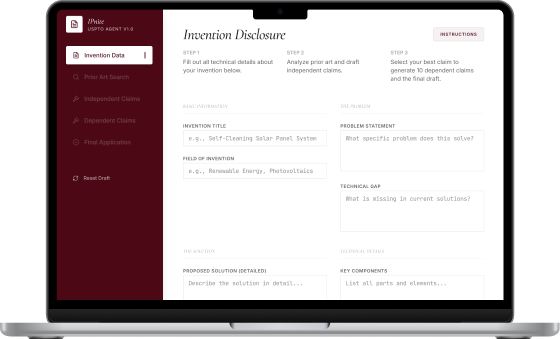
You can prepare a complete, structured application yourself, and many offices accept filings made directly by the inventor, although some require a local representative for foreign applicants. Claim scope and filing strategy are where a patent attorney or agent adds the most value, so a practical route is to arrive with a well-organized draft and pay for their judgment rather than for the basics. In IPnite™, the Discovery Agent structures your disclosure and runs the prior-art search, and The Drafter prepares the claims, description, drawings and quality review and exports a DOCX for your review. It does not replace legal advice.
Get your application ready to file
Explore a Search Strategy Preview or Draft Preview with your own invention. The 7-day free trial does not include a complete search or a final refined, exportable application. No credit card and no automatic charges.
Try IPnite™ free