
IPNITE PATENT GUIDE
What Is Patentability?
Patentability is the set of legal conditions an invention must meet to be granted a patent. The core requirements are similar across most countries.
 IPnite
The core requirements
- Eligible subject matter: the invention is not in an excluded category
- Novelty: no single prior-art disclosure already shows every feature
- Inventive step (non-obviousness in the United States): the solution is not obvious to a skilled person
- Industrial application or utility: it can be made or used in industry
- Sufficient description: a skilled person can reproduce it from the application
Excluded subject matter
Discoveries, scientific theories, mathematical methods, and abstract ideas are generally excluded. Software and business methods are treated differently by each office: the United States applies the Alice/Mayo eligibility test, while Latin American and European offices look for a technical character. Methods of medical treatment are excluded in many countries outside the United States.
Patentability is assessed claim by claim
An application is not simply patentable or not. Each claim is assessed against the prior art. That is why a good claim set includes a broad claim and narrower dependent claims that may survive if the broad one fails.
Patentability searches and opinions
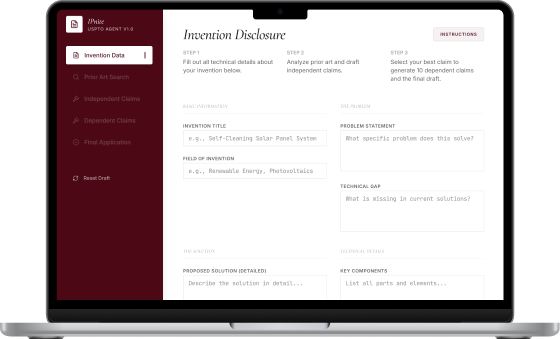
A patentability search compares your invention with the closest prior art. IPnite includes an AI-assisted patentability analysis on every paid plan; like any AI deliverable, it is yours to read or to have reviewed by a professional.
Get your application ready to file
Explore a Search Strategy Preview or Draft Preview with your own invention. The 7-day free trial does not include a complete search or a final refined, exportable application. No credit card and no automatic charges.
Try IPnite free