
AI CLAIM DRAFTING
Patent Claims Generator
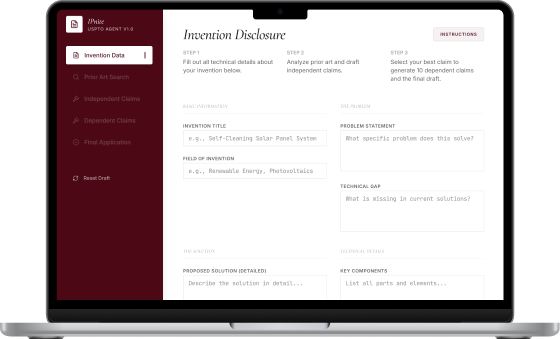
Claims decide what a patent actually protects. IPnite generates independent and dependent claims from your invention disclosure, with the closest prior art in view, so you start from a structured claim set instead of a blank page—and keep the final decisions.
Why claims are the hardest part to draft
A claim has to be broad enough to stop competitors from designing around it, yet narrow enough to be new and inventive over everything published before. It must also be fully supported by the description and use terms consistently.
Generic text generators miss those constraints because they do not know the prior art or the rest of the application. A useful claims generator works from the invention's essential features and from the references that limit its scope.
How IPnite generates a claim set
Identify the essential features
From the disclosure, the system separates the features that make the invention work from optional details.
Compare with the closest prior art
References saved from the prior-art search show which combinations are already known, which shapes where the independent claim draws its line.
Draft the independent claims
System, method, and other claim categories are proposed where the disclosure supports them.
Build dependent claims as fallbacks
Variations and optional features become dependent claims, giving narrower positions if a broad claim meets an objection.
Align claims with the description
The specification and drawings are drafted from the same project, so claim terms have support and consistent reference numerals.
Review and edit
You or your patent professional adjust scope, wording, and the number of claims before export.
Anatomy of a generated claim
A simplified, hypothetical example for a self-cleaning water bottle shows how the parts of a claim work.
| Part | What it does | Example |
|---|---|---|
| Preamble | Names the category of what is claimed | “A beverage bottle, comprising:” |
| Transition | “Comprising” is open-ended: other elements may be present | “comprising” |
| Element | A structural feature the claim requires | “a vessel defining an interior volume;” |
| Element | A second required feature | “a cap removably coupled to the vessel and including an ultraviolet light source directed into the interior volume;” |
| Element with a relationship | Shows how features interact, often where novelty lies | “a controller configured to activate the light source in response to the cap being coupled to the vessel.” |
| Dependent claim | Adds a narrower fallback | “The bottle of claim 1, wherein the light source emits UV-C light.” |
Illustrative only; not a claim drafted for a real invention.
How to review AI-generated claims
Use this before anything is filed, whether the claims came from IPnite, another tool, or a person.
- Does the independent claim include any feature disclosed by the closest reference? If so, what distinguishes it?
- Can you remove any element from the independent claim and still have a working invention? Unnecessary elements narrow protection.
- Does every term have antecedent basis (“a controller” before “the controller”)?
- Is every claimed feature described in the specification, ideally with more than one embodiment?
- Would a single competitor perform every step of a method claim, or would infringement require several actors?
- Do the dependent claims add meaningful fallback positions rather than trivial details?
- Is the claim count reasonable for the office's fees? The USPTO, for example, charges extra above 3 independent or 20 total claims.
Generated claims are a starting point
Claim scope is a legal and strategic judgment. IPnite does not guarantee that generated claims are novel, inventive, or allowable, and it does not provide legal advice. Have claims reviewed by a qualified patent professional before filing, especially when the invention has commercial value.
Frequently asked questions
Can AI write patent claims?
AI can draft a structured set of independent and dependent claims from a good disclosure. The result still needs review for scope, prior art, support, and consistency before filing.
Is IPnite's claims generator a separate tool?
No. Claims are generated inside the same project as the disclosure, prior-art search, description, and drawings, so all parts of the application stay aligned.
Which claim formats does IPnite support?
IPnite prepares claims within its drafting workflows for the USPTO, Mexico's IMPI, INPI Argentina, INPI Brazil, and PCT applications. Local conventions and office rules should be checked during review.
Does the generator check my claims against prior art?
Claims are drafted with the references saved in your project in view, and every paid plan includes an AI-assisted patentability search delivered for your review. Neither is a guarantee of novelty or a legal opinion.
Generate your first claim set
Start the 7-day free trial, describe your invention, and see claims drafted with the prior art in view. No credit card.
Try IPnite free