
FOR INDEPENDENT INVENTORS
An AI Patent Tool for Inventors
You understand your invention better than anyone. What is usually missing is the patent format: claims, a detailed description, drawings with reference numerals, and a view of what already exists. IPnite guides you through those steps and gives you a structured draft you can file yourself or take to a patent professional.
The gap between an invention and a patent application
Most inventors arrive with sketches, notes, and a prototype, not with the vocabulary of a patent office. A patent application has to describe the invention so that someone skilled in the field could reproduce it, define the protected scope in claims, and explain how it differs from earlier work.
When that translation goes wrong, the result is either an expensive back-and-forth with a professional or a self-drafted application that describes too little. An AI patent tool helps close that gap by asking the right questions and producing the structure for you to review.
What the workflow looks like in IPnite
Describe the invention in your own words
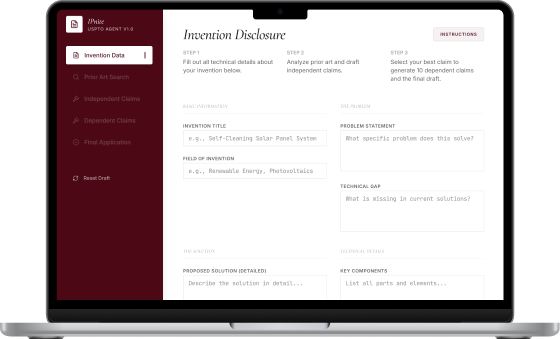
The Discovery Agent asks about the problem, how your solution works, its parts, alternatives, and advantages, and organizes your answers into an invention disclosure.
Check what already exists
Run a prior-art search by technical concept. Save the closest references to the project so they inform the draft.
Generate claims and the description
The Drafter prepares independent and dependent claims plus a detailed description, background, summary, and abstract from the same disclosure.
Create reference drawings
Generate figures whose reference numerals match the text, then refine them.
Review, export, and decide how to file
Run the QA checks, export the application as DOCX, and either file it yourself or send it to a patent attorney or agent for review. In some offices, such as INPI Argentina, you can submit the application directly from IPnite.
Follow the office from IPnite
IPnite gives you a dedicated email address to register with the patent office, so its notifications reach your project and you can answer the examiner from IPnite.
Gather this before you start
The draft can only be as complete as what you give it. Twenty minutes of preparation makes a noticeable difference.
Sketches and photos
Hand drawings, CAD screenshots, or photos of a prototype help describe structure and generate figures.
Variations
Other materials, shapes, configurations, or steps that would also work. Variations become fallback positions in the claims.
The problem and the advantage
What goes wrong with current solutions, and what measurable improvement yours provides.
Dates and disclosures
When and where you have already shown, sold, or published the invention. This affects your filing options.
Co-inventors
Everyone who contributed to at least one claimed feature may need to be named as an inventor.
Known competitors
Products or patents you already know about give the prior-art search a useful starting point.
What an AI patent tool can and cannot do for you
What it helps with
- Turning an informal description into a structured disclosure
- Finding related patents you did not know about
- Producing a complete first draft in the format patent offices expect
- Keeping claims, description, and drawings consistent
- Lowering the cost of professional review by handing over an organized draft
What it cannot do
- Guarantee that your invention is patentable or that a patent will be granted
- Replace a legal opinion on patentability, infringement, or freedom to operate
- Know business context you do not provide, such as licensing plans
- Decide your filing strategy or which countries to protect
- Take responsibility for the final text; you or your representative review it
File before you show it publicly
Public disclosure before filing (a launch, a crowdfunding page, a conference talk, a sale) can limit where you can still obtain a patent. Some countries allow a limited grace period for your own disclosures; many do not. If in doubt, file first, then talk about it.
What it costs
The Inventor plan costs $50 per month in the United States, with regional prices for Mexico, Argentina, Brazil, and the rest of Latin America. It includes one active project, two prior-art searches per month, one external collaborator such as your attorney, and DOCX export of purchased drafts. Full patent drafts are discounted add-ons. Every paid plan includes a patentability search.
Explore a Search Strategy Preview or Draft Preview with your own invention. The 7-day free trial does not include a complete search or a final refined, exportable application. No credit card and no automatic charges. Patent office fees are separate and paid to the office.
Frequently asked questions
Can I file a patent application myself with an AI-generated draft?
Many patent offices allow inventors to file on their own behalf, although some require a local representative for foreign applicants. You are responsible for reviewing the draft, and professional review is strongly recommended for anything commercially important.
Do I need to know patent law to use IPnite?
No. The Discovery Agent asks plain-language questions about your invention. Understanding the basics of claims and prior art helps you review the result, and the Learn section explains both.
Will my invention be kept confidential?
IPnite does not use your inventions, prompts, documents, or drafts to train AI models, and invention materials are encrypted in transit and at rest. The security page explains how the AI processing works.
Is an AI draft enough for a provisional application?
A provisional application must still describe the invention fully enough to support the claims you file later. A detailed, reviewed draft is far more useful than a short summary. See the provisional application page for details.
Turn your idea into a structured draft
Explore a Search Strategy Preview or Draft Preview with your own invention. The 7-day free trial does not include a complete search or a final refined, exportable application. No credit card and no automatic charges.
Try IPnite free